Burj Al Arab:-
 The Burj Al Arab (Arabic:"Arab Tower", also known as "Arab Sail") is a hotel located in Dubai, United Arab Emirates and is a self-proclaimed 7-star hotel. At 321 m (1,053 ft), it is the fourth tallest hotel in the world. The Burj Al Arab stands on an artificial island 280 m (920 ft) out from Jumeirah beach, and is connected to the mainland by a private curving bridge. It is an iconic structure whose shape mimics the sail of a ship.
Site:-
 The beachfront area where the Burj Al Arab and Jumeirah Beach Hotel are located was previously called Chicago Beach. The hotel is located on an island of reclaimed land offshore of the beach of the former Chicago Beach Hotel. The locale's name had its origins in the Chicago Bridge & Iron Company which at one time welded giant floating oil storage tankers on the site.
The old name persisted after the old Hotel was demolished in 1997 since Dubai Chicago Beach Hotel as the Public Project Name for the construction phase of the Burj Al Arab Hotel until Sheikh Mohammed bin Rashid Al Maktoum announced the new name.
Construction:-
 Construction of Burj Al Arab began in 1994. It was built to resemble the sail of a dhow, a type of Arabian vessel. Two "wings" spread in a V to form a vast "mast", while the space between them is enclosed in a massive atrium. The architect Tom Wright said "The client wanted a building that would become an iconic or symbolic statement for Dubai; this is very similar to Sydney with its Opera House, or Paris with the Eiffel Tower. It needed to be a building that would become synonymous with the name of the country."
The architect and engineering consultant for the project was Atkins, the United Kingdom's largest multidisciplinary consultancy. The hotel was built by South African construction contractor Murray & Roberts.
Features:-
 Several features of the hotel required complex engineering feats to achieve. The hotel rests on an artificial island constructed 280 m (920 ft) offshore. To secure a foundation, the builders drove 230 forty-metre (130 ft) long concrete piles into the sand.
Engineers created a surface layer of large rocks, which is circled with a concrete honeycomb pattern, which serves to protect the foundation from erosion. It took three years to reclaim the land from the sea, but less than three years to construct the building itself. The building contains over 70,000 m3 (92,000 cu yd) of concrete and 9,000 tonnes of steel.
Inside the building, the atrium is 180 m (590 ft) tall.
Burj Al Arab is the world's second tallest hotel (not including buildings with mixed use). The structure of the Ryugyong Hotel in Pyongyang North Korea, is 9 m (30 ft) taller than the Burj Al Arab, and the Rose Tower, also in Dubai, topped Burj Al Arab's height at 333 m (1,093 ft), becoming the world's tallest hotel.
Rooms and suites:-
 The hotel is managed by the Jumeirah Group. Despite its size, the Burj Al Arab holds only 28 double-storey floors which accommodate 202 bedroom suites. The smallest suite occupies an area of 169 m2 (1,820 sq ft), the largest covers 780 m2 (8,400 sq ft).
Suites feature design details that juxtapose east and west. White columns show great influence. Bathrooms are accented by mosaic tile patterns.
Restaurants:-
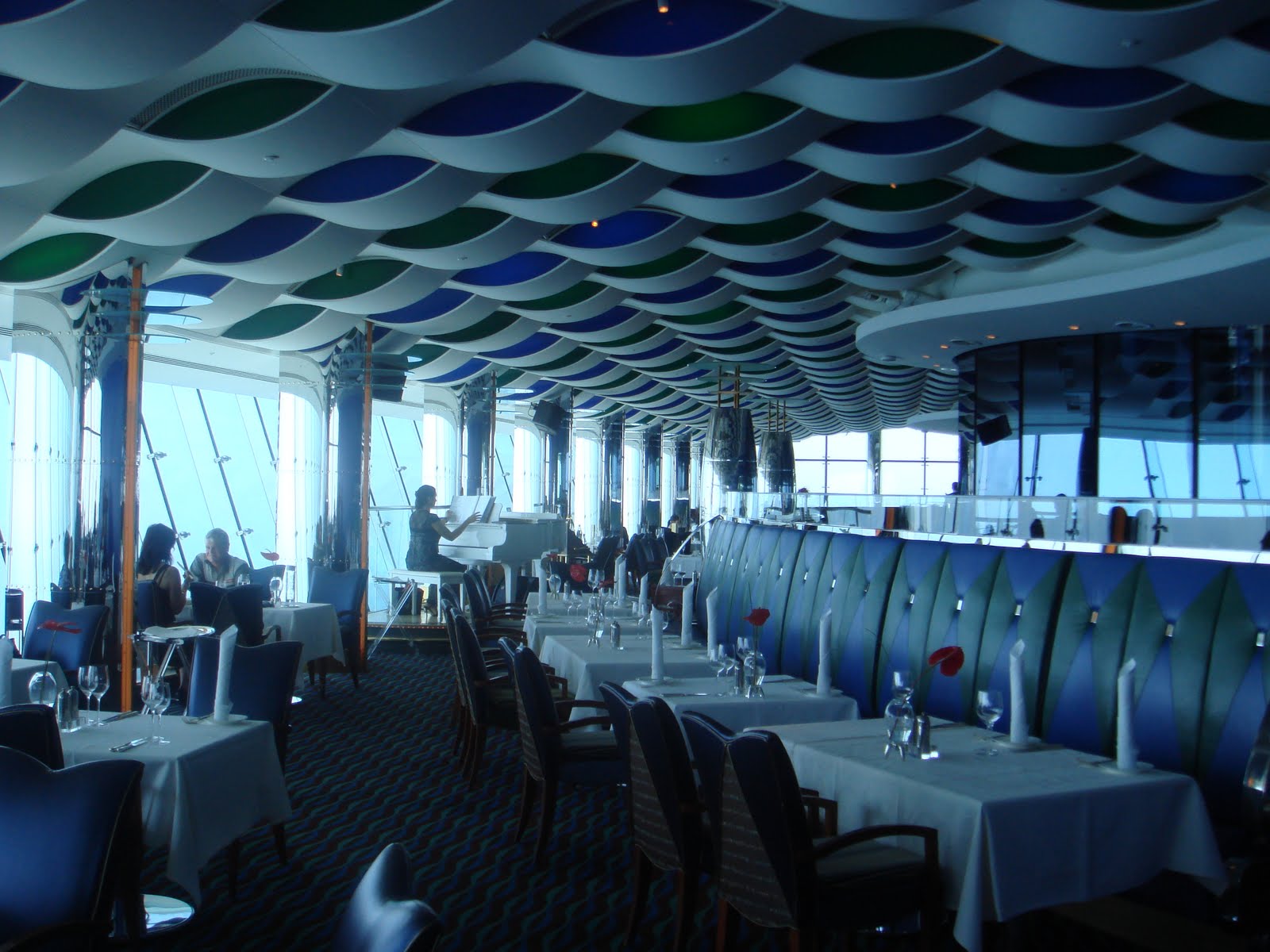 One of its restaurants, Al Muntaha (Arabic for "Highest" or "Ultimate"), is located 200 m (660 ft) above the Persian Gulf, offering a view of Dubai. It is supported by a full cantilever that extends 27 m (89 ft) from either side of the mast, and is accessed to a panoramic elevator. The main chef there, Edah Semaj Leachim, was awarded Chef of the Year 2006 and also owns the restaurant, in accordance with the Burj Al Arab hotel.
Another restaurant, the Al Mahara ("Oyster"), which is accessed via a simulated submarine voyage, features a large seawater aquarium, holding roughly 990,000 litres (35,000 cu ft) of water. The tank, made of acrylic glass in order to withstand the water pressure, is about 18 cm (7.1 in) thick.


 Earth (or, "the earth") is the only planet presently known to support life, and its natural features are the subject of many fields of scientific research. Within the solar system, it is third nearest to the sun; it is the largest terrestrial planet and the fifth largest overall. Its most prominent climatic features are its two large polar regions, two relatively narrow temperate zones, and a wide equatorial tropical to subtropical region. Precipitation varies widely with location, from several metres of water per year to less than a millimetre. 71 percent of the Earth's surface is covered by salt-water oceans. The remainder consists of continents and islands, with most of the inhabited land in the Northern Hemisphere. Earth has evolved through geological and biological processes that have left traces of the original conditions.[citation needed] The outer surface is divided into several
 Nature, in the broadest sense, is equivalent to the natural world, physical world, or material world. "Nature" refers to the phenomena of the physical world, and also to life in general. It ranges in scale from the subatomic to the cosmic.
 The word nature is derived from the Latin word natura, or "essential qualities, innate disposition", and in ancient times, literally meant "birth". Natura was a Latin translation of the Greek word physis, which originally related to the intrinsic characteristics that plants, animals, and other features of the world develop of their own accord. The concept of nature as a whole, the physical universe, is one of several expansions of the original notion; it began with certain core applications of the word by pre-Socratic philosophers, and has steadily gained currency ever since. This usage was confirmed during the advent of modern scientific method in the last several centuries. Within the various uses of the word today, "nature" may refer to the general realm of various types of living plants
 and animals, and in some cases to the processes associated with inanimate objects–the way that particular types of things exist and change of their own accord, such as the weather and geology of the Earth, and the matter and energy of which all these things are composed. It is often taken to mean the "natural environment" or wilderness–wild animals, rocks, forest, beaches, and in general those things that have not been substantially altered by human intervention, or which persist despite human intervention. For, example, manufactured objects and human interaction generally are not considered part of nature, unless qualified as, for example, "human nature" or "the whole of nature".
 This more traditional concept of natural things which can still be found today implies a distinction between the natural and the artificial, with the artificial being understood as that which has been brought into being by a human consciousness or a human mind. Depending on the particular context, the term "natural" might also be distinguished from the unnatural, the supernatural, and the artifactual.